Company
Procter & Gamble (P&G)
Industry
Cosmetics
Country
Worldwide
Employees
99,000
Why does P&G use Domino?
As one of the world’s largest consumer goods manufacturers, P&G is actively promoting accessibility. The goal of the project was to modify the bottles in the Herbal Essences bio:renew hair care line so that blind and visually impaired people could immediately identify the shampoo and conditioner by touch while in the shower. Since Braille is known only to a small fraction of people with visual impairments, P&G sought a universal, tactile symbol solution that could be implemented flexibly and cost-effectively in global production.
What challenges had to be overcome?
The change in bottle design could not slow down the enormous line speeds of hundreds of bottles per minute at the bottling plants. Furthermore, a mechanical modification of the bottle shape was out of the question for cost reasons—the tactile markings had to be applied directly to the existing bottles during the ongoing production process. The biggest technical hurdle: The markings could not pierce or weaken the PET material at any point in order to absolutely guarantee the stability and leak-tightness of the bottles throughout the entire logistics chain.
What does Domino's solution look like?
Working closely with Domino’s development labs, a highly innovative solution was developed using D-Series CO₂ lasers, in which the tactile symbols are precisely etched into the bottle wall.
Selecting the Optimal Material Thickness
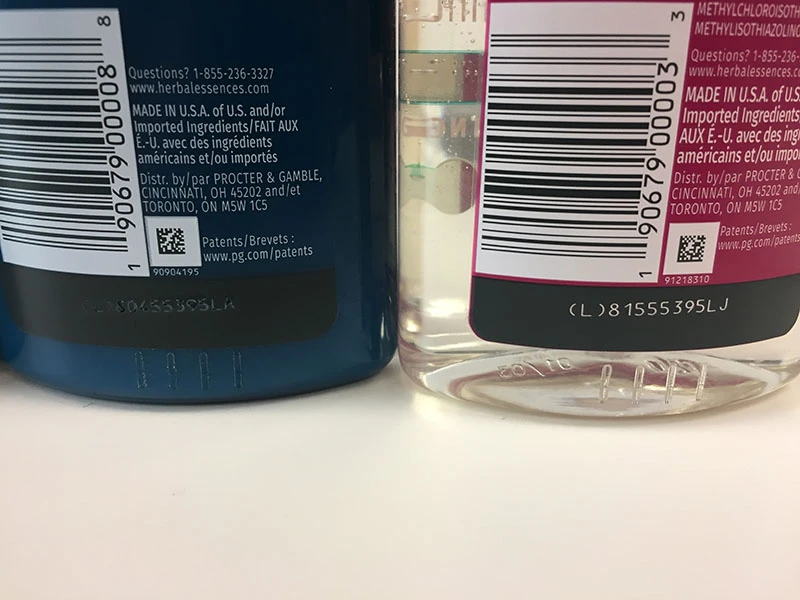
The coding is applied precisely at the bottom of the bottle, since the plastic is thickest there and the structure of the packaging is not compromised.
Applying the Universal Code
The laser applies a series of raised, vertical lines to the shampoo bottles, while the conditioner bottles are marked with two rows of raised dots.
Color-independent application
Domino selected a laser wavelength at which energy absorption is completely independent of the bottle's color—this allows the system to be used for all color variations without any adjustments.
Fully Integrated High-Speed Process
The lasers are seamlessly integrated into the existing filling lines and mark the bottles without contact while the production line is running at full speed.
Why the D-Series Lasers Were the Ideal Choice for P&G
Maintaining Packaging Integrity
Extensive 3D microscopy tests conducted in the Domino laboratory demonstrated that the structural strength and barrier properties of the PET bottles remain 100% intact despite thermal degradation.
No Loss in Productivity
The system operates extremely quickly and integrates seamlessly into existing high-speed production lines as a purely software- and hardware-based adaptation, without increasing cycle times.
Global Replicability
The solution is designed to be so flexible that other plants and even contract fillers can adopt the setup directly for different brands without the need for expensive specialized tools.
“Working with Domino was fantastic. Throughout the entire process, it was a true partnership that made this solution possible. That gave us the confidence to successfully bring the product to market.”
Kevin Higgins, Engineer at P&G
Do you have any questions about our cobots?
Contact Us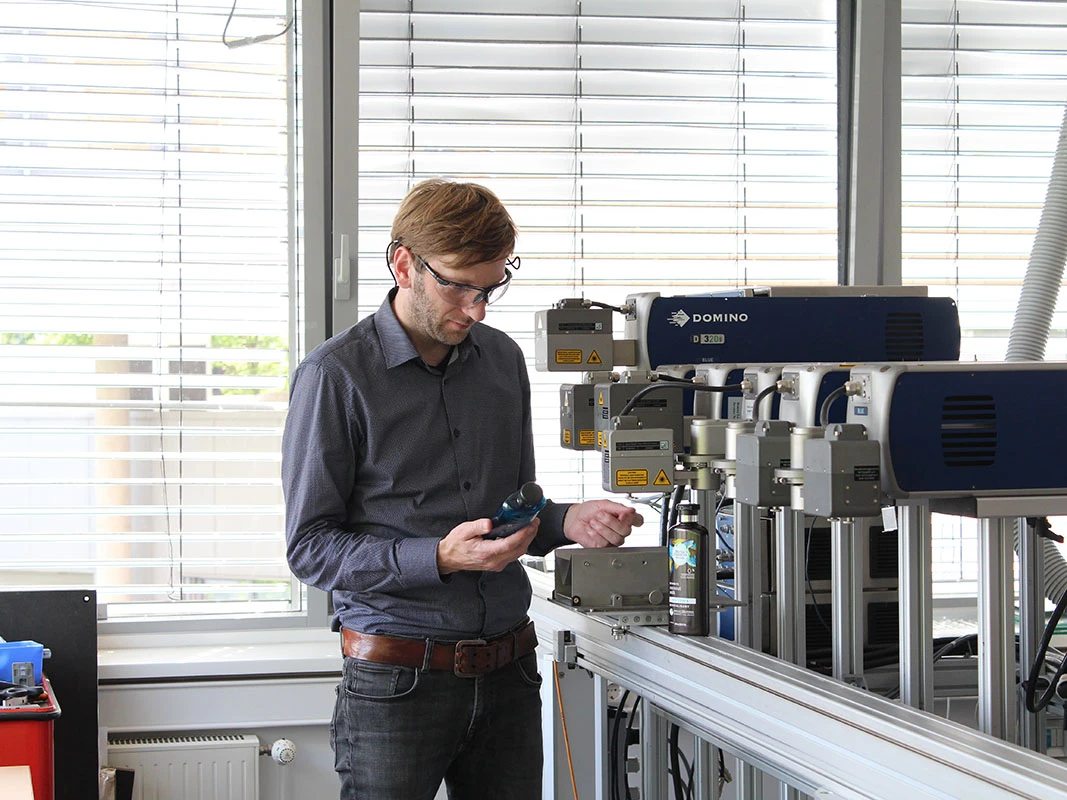
Precise Automation for the Highest Quality Standards
The implementation of Domino laser technology has made P&G a pioneer in inclusive packaging design in the cosmetics industry. The tactile-coded bottles have received overwhelmingly positive reviews from organizations for the blind (such as the RNIB) and give millions of consumers a greater sense of independence in their daily lives. Because the transition neither reduced production line efficiency nor incurred additional material costs, P&G was able to roll out the inclusive design across the entire U.S. market without raising prices.